


VIETNAM AVIATION ACADEMY ORGANIZES A SPECIALIZED SEMINAR ON 5D DIGITAL TWIN AND SMART INFRASTRUCTURE MANAGEMENT
On the morning of September 18, 2026, at the Vietnam Aviation Academy, the Digibuild research group organized a specialized seminar titled: “Digital Twin 5D Smart City Public Works Management and Decision Support Platform”. The program was attended by lecturers, researchers, and students interested in the fields of Digital Twin, BIM, GIS, smart cities, infrastructure management, and digital transformation in construction and aviation.
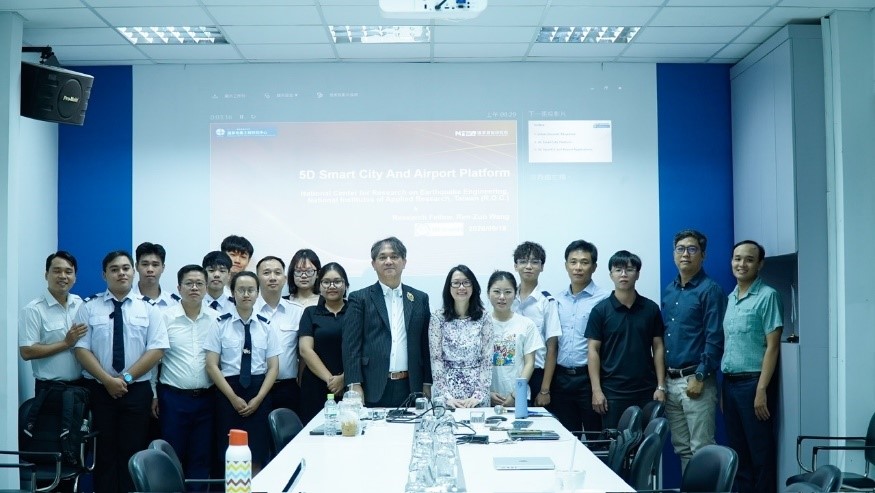
The speaker of the seminar was Dr. Ren-Zuo Wang, currently working at the National Center for Research on Earthquake Engineering (NCREE), Taiwan, under the National Institutes of Applied Research (NIAR). His research focuses on numerical methods to simulate damage concentration and the collapse process of bridge structures and construction works. In addition, he studies the non-linear dynamics of large-scale structures through shake table experiments. He also develops numerical models to analyze the non-linear behavior of steel structures under fire conditions—taking into account the post-fire cooling phase—as well as the large deformation of structures subjected to high temperatures. He has served as the principal investigator for numerous research projects supported by the Ministry of Science and Technology, while also providing solutions and technical support for digital transformation projects in smart infrastructure.
Furthermore, Dr. Ren-Zuo Wang is the developer of the 5D Smart City Platform – 5D SmartES Platform, a multi-source integrated Digital Twin platform serving management and decision-support tasks for several prominent projects, including:
– In Kaohsiung City, Taiwan: The platform was deployed to solve practical problems by integrating Big Data, IoT, and AI.
– In Shalun District C, Tainan, Taiwan: Implemented the 5D Intelligent Operation Management System, applying a digital urban model to the management and operation of the Shalun C area. This project was recognized within the framework of a smart living space innovation competition.
– National Taiwan Museum (2024): NCREE collaborated with the National Taiwan Museum to develop the 5D Smart Structural Safety Monitoring System to monitor structural health in real-time, helping to ensure safety for visitors and artifacts.
– Urban Tree Monitoring: An inclination sensor system was installed on trees to track the risk of falling and send multi-level alerts, serving urban tree safety management.
– Japan – Shutoko (2025): The development team worked with Shutoko (Metropolitan Expressway Company) and signed a Non-Disclosure Agreement (NDA), opening up directions for cooperation in applying Digital Twin technology to transport infrastructure management in Japan.
– Thailand – Smart Factory (since 2022): 5D SmartES began expanding into smart factory models, combining the Digital Twin platform with operational management and monitoring.
Additionally, in 2023, one of the team’s systems won an award at the Smart City Innovation Application Awards under the disaster prevention innovation application category.
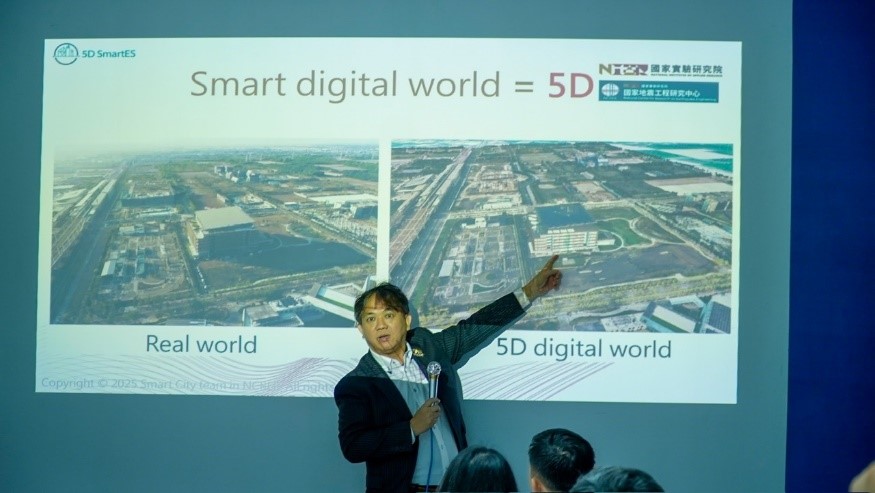
Dr. Ren-Zuo Wang, National Center for Research on Earthquake Engineering -NCREE)
5D SmartES is built on a GIS platform and integrates multiple data sources, including:
– Building Information Modeling – BIM
– GIS Data
– Satellite and Aerial Imagery
– LiDAR Point Cloud Data
– Camera Feeds and Real-Time Field Data
– Building, Traffic, and Urban Technical Infrastructure Information
Integrating these data sources helps form a “digital twin” of the real world, supporting visualization, monitoring, analysis, and facility management throughout its lifecycle.
Through practical projects in Taiwan, the speaker introduced various applications of 5D SmartES in public works management, such as:
– Management of new construction and existing structures;
– Management of roads, bridges, and maintenance work;
– Management of parks, trees, and urban landscape;
– Management of pipelines and underground utilities;
– Construction site safety monitoring;
– Real-time image monitoring of structures;
– Disaster response and decision support.
In particular, connecting Real-time Construction Images with the Digital Twin model allows managers to directly monitor jobsite conditions in a digital environment, contributing to improved efficiency in progress, quality, and safety management.
A notable point during the seminar was the potential to expand the 5D SmartES platform from Smart City to Smart Airport, unlocking opportunities for Digital Twin applications in aviation infrastructure management and operations.
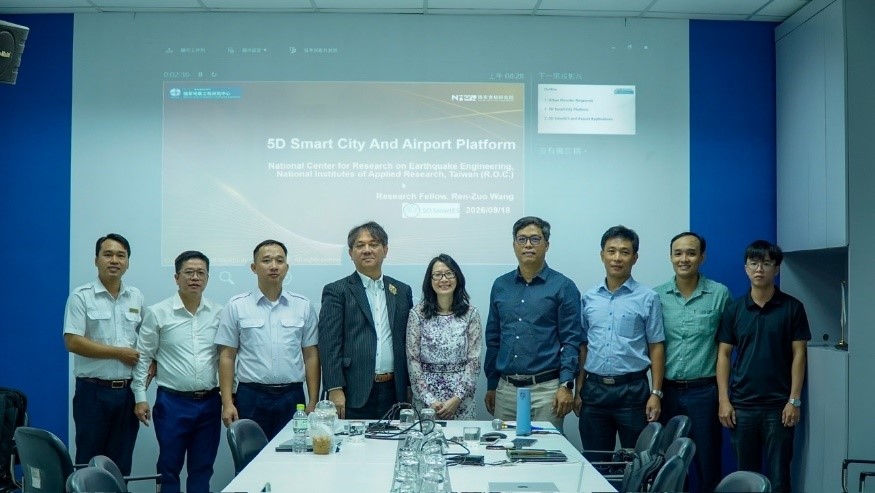
Beyond the technical presentations, the seminar provided an opportunity for lecturers, researchers, and attendees to engage in direct discussions with Dr. Ren-Zuo Wang regarding application directions for Digital Twin, BIM, GIS, and digital technologies in infrastructure management. The seminar contributed to updating new technological trends while opening interdisciplinary research directions: Digital Twin – BIM – GIS – Smart City – Smart Airport – Infrastructure Management – Disaster Resilience – Decision Support Systems.
Through this academic activity, the Vietnam Aviation Academy continues to promote research, innovation, and international connectivity, step-by-step approaching advanced technologies to serve digital transformation in the construction and aviation sectors.
KHCN&HTQT


What is a UAV? What is a drone? What is the difference between UAV and drone?


Vietnam Aviation Academy compiled national standards on ground radio navigation aid systems
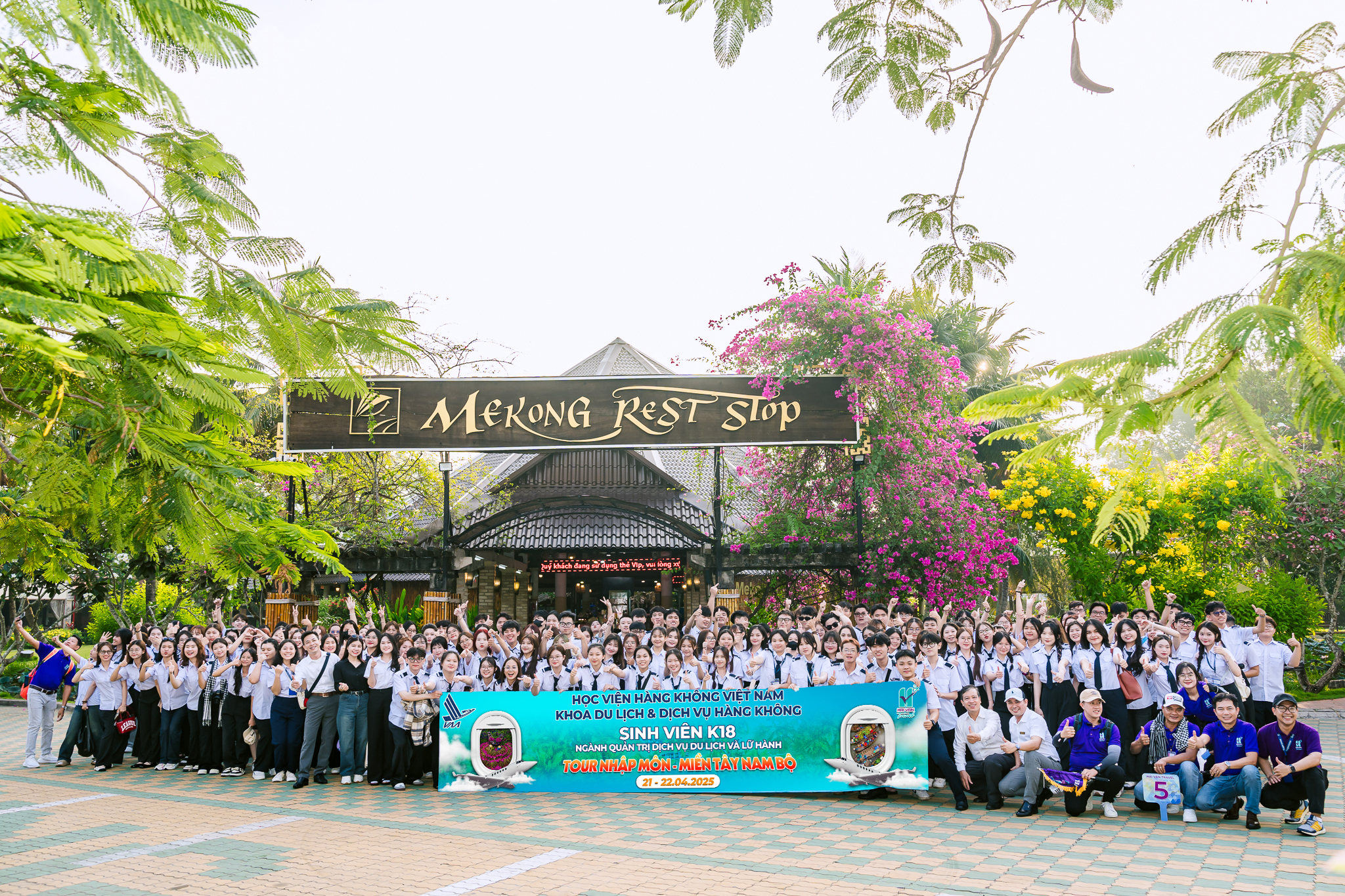
EXPLORING THE MEKONG DELTA: A TWO-DAY ONE-NIGHT JOURNEY
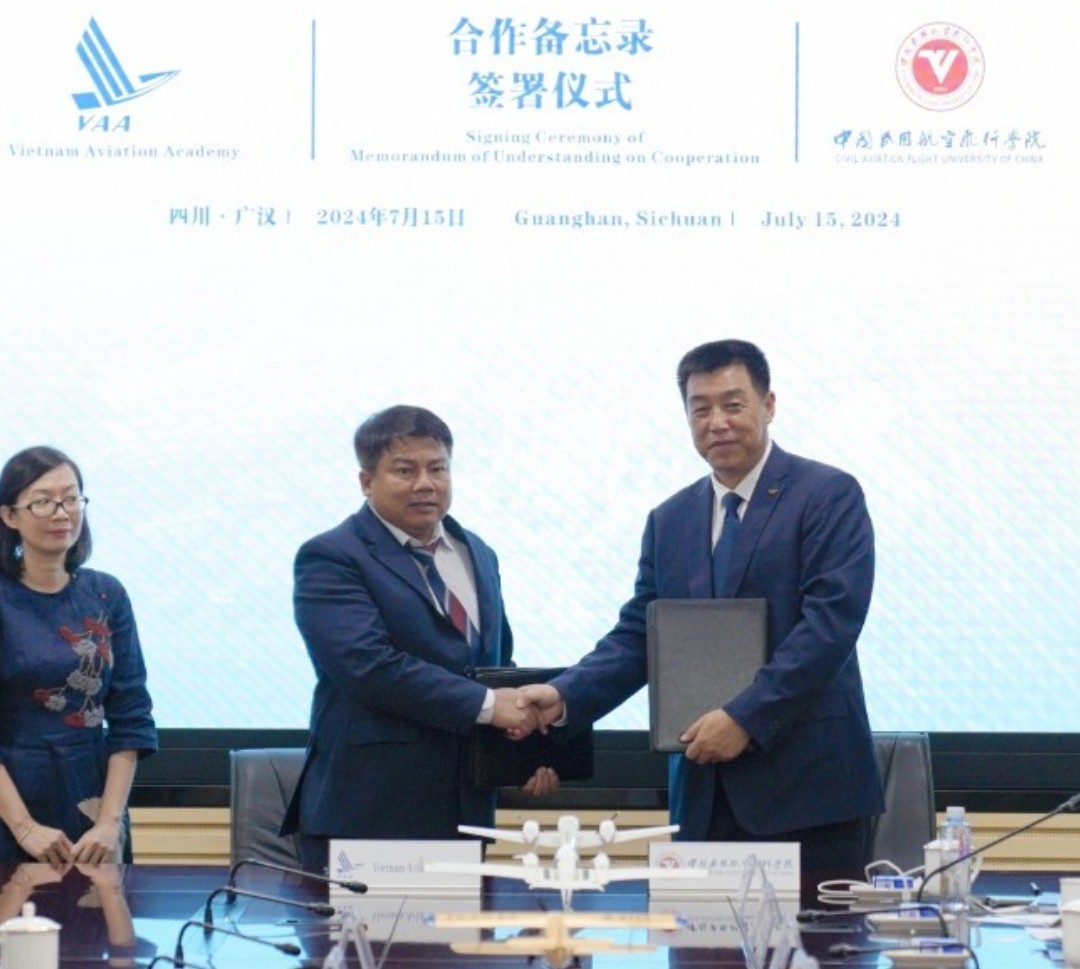
VIETNAM AVIATION ACADEMY HAS SIGNED A COOPERATION AGREEMENT WITH CIVIL AVIATION FLIGHT UNIVERSITY OF CHINA

The Impact of Artificial Intelligence on the Global Economy: An Ongoing Revolution

Degree verification
Check now